Burial Enclosure Inscription
The burial enclosure at Glengyle House carries an inscription panel above a heraldic relief.
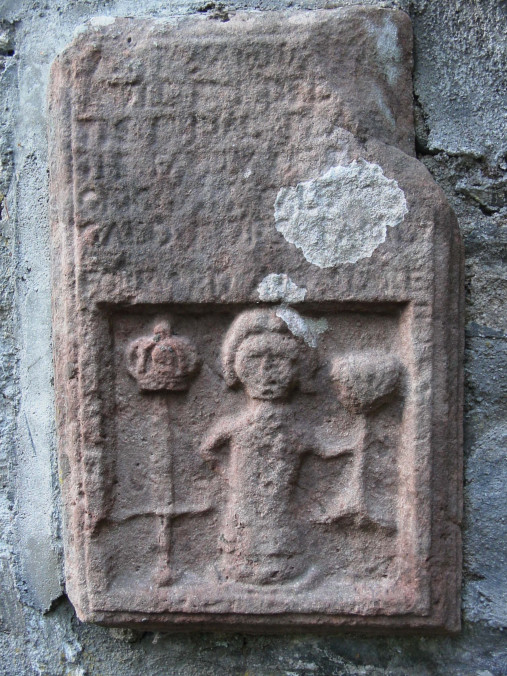
Glen Discovery noted the text as:1
P Bell builded the burial place of the family of Mac Greggars called Dugald keirs family. Forevard and spare not.
Initial reasoning
Working from the photo of the stone directly, it was determined that the lettering runs across seven lines:
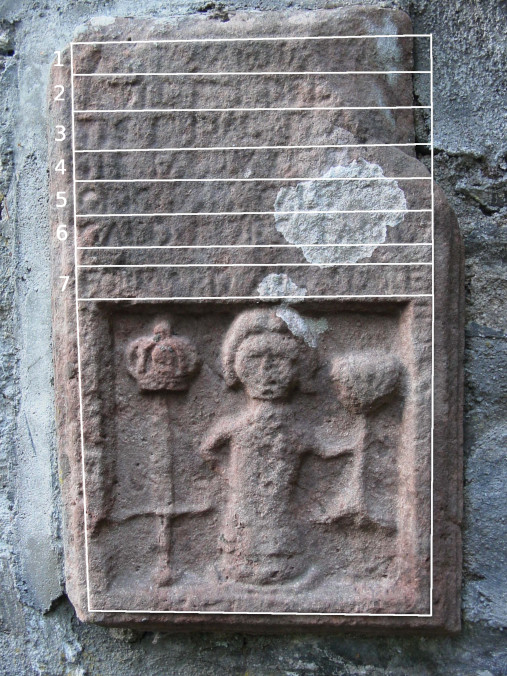
1
2   PBELL BVILDED
3   THE BVRIAL PLACE OF
4   THE FAMILY OF MAC
5   GRIGGAR CALLED DV
6   GALD KEIRS FAMILY

7   FOREVARD AND SPARE
                     N
                     O
                     T
The most obvious letters are “A” 2nd position on row 6, and “E” at the end of row 7. It became clear that row 7 ended with “SPARE” and that the expected word “NOT” runs down vertically on the right edge of the stone. So that confirmed that the inscription was along the lines that were expected. Then it was a case of reading the remaining rows with a view to reconstructing the text.
It was noticed that there's no discernible gap between “P” and “BELL” - the two are joined together. Considering the way words are split between rows it seemed more likely that the builder was a “CAMPBELL”.
The first row is largely illegible. Lines 2-7 can be confirmed with reasonable confidence if we know more-or-less what to look for. Some guesswork was applied to consider the first row. After staring at it for a long time there was no clear way to determine what was written, but a spiral shape in the middle of the row seemed to be there. There were potential numbers to the left of this, including two potential number sevens, but no clear way to determine a single year date.
Stylistic evidence
The carving conventions on the stone point to a tight date bracket.
| Evidence | Constraint |
|---|---|
| Pure V-for-U throughout (no U anywhere in surviving text) | c. 1640-1700; rare after c. 1720 |
| Single V-for-W in FOREVARD | Self-conscious Roman classicism; c. 1600-1700 |
| Archaic form BVILDED (“builded”) | KJV register; rare after c. 1700 |
| Phonetic Scots GRIGGAR (pre-standardised) | 17th c. natural; awkward by mid-18th c. |
| MacGregor charge (crown ensigned on sword) displayed openly | Legal only 1661-1693 and post-1774 |
| Explicit naming of “MacGriggar” in the inscription | Same window: 1661-1693 most natural |
| MacGregor motto “Forewart and spair nocht” | Identifies clan affiliation regardless of patron's surname |
| Inscription-panel-over-emblem-panel format with moulded frame | c. 1620-1730 |
| Folk-art frontal figure (central emblem) | c. 1640-1720 |
| Roman capitals, blocky, deeply cut, irregular proportions | c. 1600-1750 (broad) |
Stylistic bracket: c. 1660-1700, most naturally 1661-1693.
Genealogical evidence
- V: Domhnall Glas d. 1693, Glengyle. m. Margaret Campbell of Glenlyon.
- VI: Eoin d. January 1694, Glengyle. m. Christian Campbell of Duneaves.
- VII: Griogair glun dubh b. 1689 - aged 4-5 at succession.
- Raibart Ruadh (Rob Roy) b. c. 1671, brother of Eoin, uncle of the new chief.
Two consecutive chieftains died at Glengyle within months of each other, leaving a four-year-old successor. The Acts of Proscription against the MacGregor name were re-imposed in August 1693, between the two deaths. Rob Roy - the senior adult male of the immediate line - operated openly under the surname Campbell during this proscription.
Combined reading
The enclosure was almost certainly built c. 1694-c. 1710 as the dynastic response to the double bereavement of 1693-94, under the patronage of Rob Roy MacGregor acting as Campbell, on behalf of his orphaned minor nephew Griogair glun dubh. The stone's surface contradictions resolve cleanly:
- The Campbell patron-name reflects the post-1693 legal reality.
- The MacGregor heraldry and motto assert the actual identity the law forbade naming.
- The “Dugald Keir's family” specification publicly identifies the lineage (Clandoulkeir) when the surname cannot.
- The deceased are Rob Roy's own father and brother.
The stone as a whole makes most sense as a post-1693 proscription-era monument by a patron managing legal risk through formulation - lineage-name alongside surname, Campbell signature - and physical setting (private enclosure in clan stronghold), rather than as a pre-1693 stone that needed no such management.
Rob Roy was realistically in a position to commission this work only between roughly 1703 and 1711, with the most likely sub-window being c. 1703-c. 1707.
Returning to the first row
We could be fairly confident that the first row contained a year date, and without any clear pattern to follow, an initial guess of 1707 with two 7s. This is approximately the year the house was built, recorded in a letter from Rob Roy requesting timber for his nephew to build the house. The nephew, Griogair glun dubh, was married to Mary Hamilton in 1708.
The first letter on the first row could be an “A” with a leading curve, indicating a “long A” or “A with stroke” style. A guess was made that this represents “AD” with it being considered common to prefix “AD” to the date rather than after, as in “1707 AD”.
Going back to the original approach, it was easier to trace the letters with some clue on what to look for. So given these assumptions, the first row was re-examined, and the letters traced to try to determine with some confidence, not really expecting confirmation since the first row is the most eroded of all, and all of it is near impossible to read. However, on re-examining the first row, it seemed natural to make out the forms of something like “Az 1705”, and though the apparent “z” seems unusual, as an “N” on its side it could be considered a stylistic form of “Anno”, potentially.
The number 5 seems quite clear now, not a 7 or another number. However, there is a superscript-like marking to the right of the number which was one of the markings that made it confusing to read.
Moving on, looking to the right of the spiral it seems likely that what we see is an “R”, which reinforces the potential for the missing stone to continue as “ROB CAM”.
Photograph and tracing
The tracing of the inscription is shown below, with the photograph on the right and the tracing on the left. You can use the slider to compare the two.
An imaginary illustration
The image below is constructed through iterative regeneration using Adobe Firefly. Manual editing and examples have been applied between iterations to steer the model towards the desired output. It is an attempt to faithfully recreate elements from the original photograph. It should be noted that this is not a reproduction. It is an imaginary recreation. For example, the lettering is much more regular and consistent than the original, which is not exactly this style of text. Also, it does not line-up perfectly with the original, and text has been added in as the original corner of stone which has been lost.
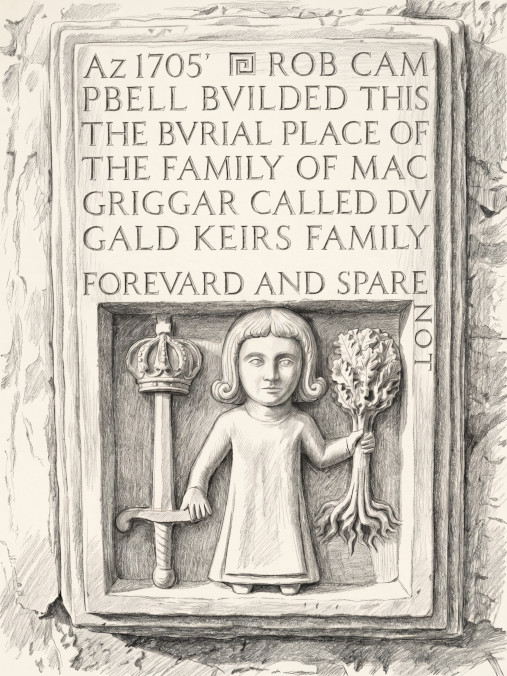
It is likely also that the figure was more basic than this, not as detailed, but no doubt that there was significant detail suggested in the crown and the tree presented in the original photograph.
Conclusion
It does not require a stretch of the imagination to believe that Rob Roy was the sponsor of the graveyard enclosure, given a related role in arrangements for the building of the nearby house. It was still unexpected to see what could have been an explicit attribution to Rob Roy himself. It seems relevant in the context of maintaining the family lineage, since the line of MacGregor of Glengyle continued right here for many more generations, following the establishment of these buildings.
Footnotes
-
Peter Lawrie, “Glengyle House”, Glen Discovery. ↩︎